Is my bilingual toddler a late talker? What the research says
Learning two languages doesn't cause speech delays. Bilingual kids who seem behind are usually further along than they look, because their words are split across two languages and most checklists only count one.
This is one of the most common worries in multilingual families, and it often comes from well-meaning relatives, or even professionals, suggesting you drop a language "until they catch up". The research points the other way.
First words arrive on time
The best recent evidence compares 302 Polish-speaking children growing up abroad with a second language against 302 matched children in Poland who heard only Polish. Both groups said their first word at about 15 months on average, and the researchers found evidence for no difference in when children started babbling, reached ten words or put their first words together (Muszyńska and colleagues, 2025). The data came from parents logging milestones in an app, and fewer families reported the later milestones, but it's a large and carefully matched comparison and it lines up with earlier reviews.
Why bilingual vocabularies look smaller than they are
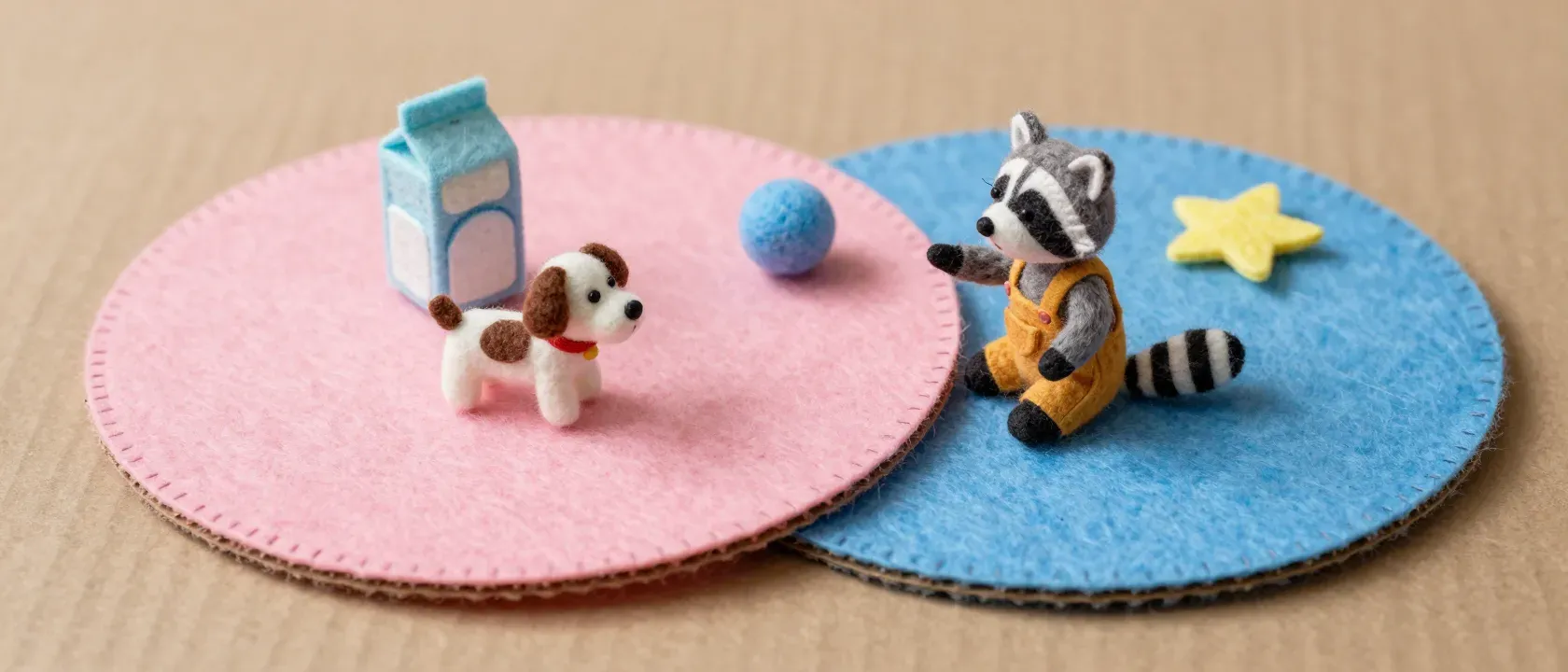
Say a toddler hears German and English. She says "Hund" for dog, "ball" for ball, "Milch" for milk and "more" for more. Count only the German and you get two words. Count only the English and you also get two. Count both and you get four, which is her real vocabulary.
Researchers who count this way find bilingual toddlers right on track. A study that compared 47 Spanish and English toddlers with 56 English-only toddlers found that at 30 months the bilinguals averaged about 580 words across both languages, against about 540 in English for the monolinguals, a difference that wasn't significant (Core and colleagues, 2013). Counting only concepts, so that dog and perro count once, made the same children look behind and flagged more of them as at risk, which is why the authors back the plain total. Their advice to clinicians is to fill in a word checklist in each language, add them up, and subtract only words that sound almost the same in both, like banana (Hoff and Core, 2015).
Two more things are normal. Each single language often trails a monolingual child's a little, since learning two languages takes longer than one, though not twice as long (Hoff and Core, 2015). And bilingual toddlers often understand more than they say, so a child who answers your Italian question in German has usually understood it perfectly. Reviews also find that bilingual children are no more likely than monolingual children to have language difficulties, and that delays and disorders occur at the same rates in both groups (Byers-Heinlein and Lew-Williams, 2013; Fibla and colleagues, 2021).
So when you check a milestone list, add up the words in every language your child speaks. A little notebook on the fridge where both parents jot down new words works well, and it's usually reassuring.
Mixing and switching are normal
Bilingual toddlers borrow shamelessly. "Mehr juice," an Italian verb with an English ending, an answer in the "wrong" language: all expected. Researchers call mixing a normal part of bilingual development and a sign of resourcefulness, since the kid just grabs whatever word they've got. Bilingual adults do the same thing all day.
You don't need to correct it. An easy move is to repeat the sentence in your language so they hear the word they were missing: "More juice? Yes, mehr Saft."
A quiet phase can be normal too
Kids who meet a new language later, say when daycare starts in a language they've never heard, often go quiet in it for a while. They're listening and soaking it in. Many start talking after a few weeks or months, sometimes in whole phrases, which makes for a great surprise at pickup.
When it's worth asking a professional
Bilingualism doesn't cause a delay, but it doesn't protect against one either, so trust your gut. Milestone checklists like the CDC's milestones by age are a useful guide once you count words across all languages. Talk to your pediatrician or a speech and language therapist if, counting every language, your child isn't using any words by around 18 months, isn't putting two words together by around two, doesn't seem to understand simple requests, or seems to be losing words they used to have.
When you do see someone, tell them about every language your child hears and ask for an assessment that counts all of them. A professional who only tests one language can make either mistake: calling a typical bilingual child delayed, or waving off a real problem as "just bilingualism" (Hoff and Core, 2015).
Keep both languages, even with a diagnosis
Parents of children with a language disorder, autism or Down syndrome are still sometimes told to stick to one language. The evidence doesn't support that advice, and researchers who review it call it unfounded (Fibla and colleagues, 2021). A 2023 systematic review of 22 studies of multilingual autistic children found no sign that more than one language harmed their language or communication, and pointed out that asking parents to give up a language can hurt family interaction (Gilhuber, Raulston and Galley, 2023). Children with Down syndrome raised with two languages scored at least as well in English as children with Down syndrome raised with one, though that study had only eight bilingual children (Kay-Raining Bird and colleagues, 2005).
For children with a developmental language disorder, a review of therapy studies found that therapy in both languages helped the second language as much as therapy in the second language alone, and supported the home language as well (Harvey, Allaway and Jones, 2018). In a randomized trial with 202 preschoolers with language impairment, vocabulary teaching in Spanish and English built both languages, while English-only teaching built only English (Restrepo, Morgan and Thompson, 2013). Dropping a language rarely helps, and it often means a parent stops talking to their child in the language they're most comfortable in.
Meanwhile, keep talking, reading and playing in every language you've got. For ideas on keeping the home language strong, read how to raise a bilingual child.
Questions parents ask
Do bilingual children start talking later?
No. A study of 302 bilingual and 302 matched monolingual children found both groups said their first word at about 15 months and reached early milestones at the same ages. Vocabulary in each single language can look smaller, so count words in all languages together.
Should we drop one language if our toddler is talking late?
Usually not. Bilingualism does not cause delays, and dropping a language often means a parent stops using the language they speak most comfortably with their child. Ask a professional for an assessment that counts every language.
Our child has autism or a language disorder. Should we use only one language?
Reviews of the research find no evidence that a second language harms autistic children or children with a language disorder, and therapy in both languages supports the home language without slowing the second one. Talk to a therapist who will work with both languages.
Is it bad when my toddler mixes languages?
No. Mixing words from two languages in one sentence is a normal part of bilingual development and shows the child is using every word they know.
When should I worry about my bilingual toddler's speech?
Counting every language, talk to a pediatrician or speech and language therapist if there are no words by around 18 months, no two-word phrases by around two, little understanding of simple requests, or a loss of words.
Sources
- Bilingualism in the early years: what the science says, Krista Byers-Heinlein and Casey Lew-Williams, LEARNing Landscapes, 2013
- Bilingual children reach early language milestones at the same age as monolingual peers, Karolina Muszyńska and colleagues, Journal of Child Language, 2025
- Total and conceptual vocabulary in Spanish-English bilinguals from 22 to 30 months: implications for assessment, Cynthia Core and colleagues, Journal of Speech, Language, and Hearing Research, 2013
- What clinicians need to know about bilingual development, Erika Hoff and Cynthia Core, Seminars in Speech and Language, 2015
- Bilingual language development in infancy: what can we do to support bilingual families?, Laia Fibla and colleagues, Policy Insights from the Behavioral and Brain Sciences, 2021
- Language and communication skills in multilingual children on the autism spectrum: a systematic review, Christina Gilhuber, Tracy Raulston and Kasie Galley, Autism, 2023
- The language abilities of bilingual children with Down syndrome, Elizabeth Kay-Raining Bird and colleagues, American Journal of Speech-Language Pathology, 2005
- The effectiveness of therapies for dual language children with developmental language disorder: a systematic review, Hannah Harvey, Hazel Allaway and Sarahjane Jones, International Journal of Bilingual Education and Bilingualism, 2018
- The efficacy of a vocabulary intervention for dual-language learners with language impairment, M. Adelaida Restrepo, Gareth Morgan and Marilyn Thompson, Journal of Speech, Language, and Hearing Research, 2013
- Milestones by 18 months and 2 years, US Centers for Disease Control and Prevention
Keep reading
How to raise a bilingual child: what actually works in the toddler years
Raising a bilingual or multilingual toddler? What research says about one parent one language, speaking the minority language at home, and how much each language needs.

How to keep your home language alive when daycare starts
When daycare or school starts, children often switch to the community language. How multilingual families keep a heritage language strong, with research and simple routines.